

Wildfire management: lessons learned and future challenges. The experience of Castilla y León
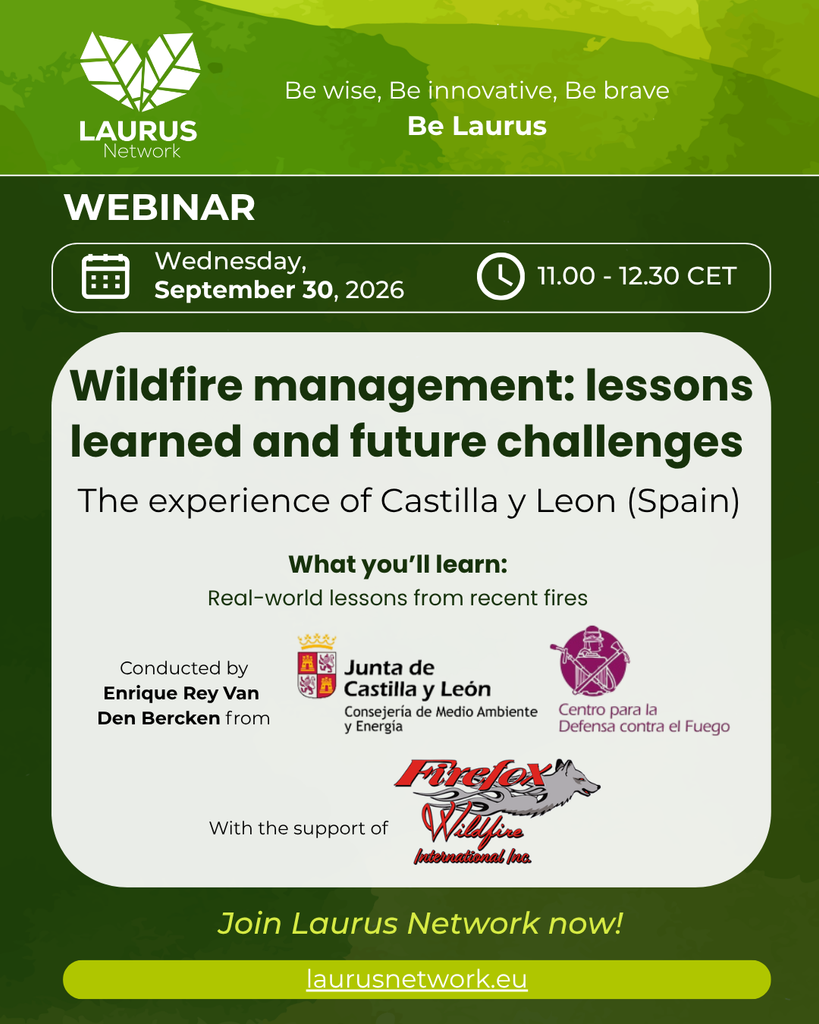
📣 📣 Wildfire management: lessons learned and future challenges. The experience of Castilla y León
🗓️ Date: Wednesday 30 September 2026
⏰ Time: 11:00–12:30 CET
🗝️ Access: Registered members of Laurus Network
Missed the live session? The full recording is now available in the Laurus members’ area.
The Laurus Network webinar held on 30 September looked at how forest fires are changing in the north-west of the Iberian Peninsula, using Castilla y León as a case study. The speaker was Enrique Rey, from the Centre for Fire Defence of the Regional Government of Castilla y León, who has worked in wildfire management for more than 30 years.
Rey described a paradox in the region: the number of fires keeps falling and nearly 8 in 10 are contained at under one hectare, yet a few reach sizes never seen before. Over the previous 25 years there had been four fires larger than 5,000 hectares. Since 2021 there have been more than 20. In August 2025, Castilla y León had more than 40 active fires a day for two weeks. In 2026, a single fire set a new record, affecting 37,818 hectares of forest land, 27,600 of them wooded area.
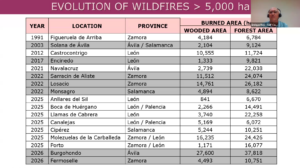
According to Rey, several factors are adding up. One is extreme weather that is becoming more frequent. Another is fuel that dries out faster than usual. On top of that, the wooded area has doubled in 40 years, the landscape is increasingly continuous, and rural areas are depopulated and ageing. For this reason, he argued that the answer is not more firefighting resources but long-term action: involving the whole of society, planning the landscape across public and private land, offering incentives to private forest owners, improving villages’ ability to protect themselves, and strengthening cooperation between regions and countries.
In the second part of the session, the company Firefox Wildfire International gave a live demonstration from Canada of its Barricade gel. The company presents it as a product that puts fire out on contact and can be used from both ground and aerial equipment.
The session is part of the activities of the Laurus Network, an initiative of the SMURF project that supports European forest owners’ organisations, coordinated by the Cesefor Foundation.
The full webinar recording is available free of charge to registered members of the Laurus Network. Joining the network unlocks access to this and other sector-focused webinars, training materials and exchange opportunities with forest experts across Europe.
Be wise, be innovative, be brave — be Laurus.